
How to Hold Yourself Accountable to Your Goals
Updated
Here’s how to hold yourself accountable when nobody else is checking: decide the goal and the end date before you start, check in on a fixed daily schedule, and attach a real consequence to a miss. The consequence doesn’t have to be money. In Lock In, a missed day ends the run and the next attempt starts from day one.
You don’t need a coach or a partner for any of this. You need rules you set while you’re motivated, written down so your tired self can’t quietly rewrite them.
What self-accountability means
Accountability means answering for what you said you’d do. With a manager or a coach, someone else asks the question. With self-accountability, you ask it yourself, and you accept the answer.
That’s the hard part. The person checking is the same person who wants to skip, and they have excuses ready: it’s been a long day, today doesn’t really count, I’ll do double tomorrow. Self-accountability gets easier when the rules are decided in advance and the daily check is a yes-or-no question you can’t argue with.
How to hold yourself accountable in five steps
Decide it up front
Before day one, write down three things: the goal, the end date and the daily todos. Make them specific enough that a stranger could check them. “Get fit” can’t be checked. “Walk for 20 minutes” and “No phone for the first hour after waking” can.
Then stop editing. Rules you can change mid-run aren’t rules. If something turns out to be wrong, fix it for the next run. If you haven’t picked the goal yet, start with how to lock in on one goal, and for help with the list, see how to set daily goals you can finish every day.
Check in at the same time every day
Pick a check-in time and keep it, for example 9 pm. The question never changes: did I do every item on today’s list? Yes or no. A fixed time means you never have to remember to ask, and a yes-or-no answer leaves no room for “sort of.”
Keep a written record
Mark every day, done or missed, somewhere you’ll see it. A record turns a vague feeling (“I’ve been pretty good”) into a fact you can count.
There’s good evidence for this step. A 2016 meta-analysis of 138 studies, with nearly 20,000 participants, found that interventions that got people to monitor their progress more often helped them reach their goals. The effect was larger when progress was reported or made public, and when it was physically recorded (Harkin et al., 2016).
Make a miss cost something
Decide before you start what a miss costs. Without a cost, skipping is free. The cost doesn’t need to be money. It can be:
- Starting the count again from day one.
- Writing one honest line about why you missed before you start again.
- Telling one person that you missed.
Pick one, write it next to your goal, and apply it every time. A cost you waive once becomes easy to waive again.
Restart cleanly
A miss is information, not a verdict. When one happens, pay the cost you agreed on, note what got in the way, and start again the next day. Don’t wait for Monday or the first of the month. Keep the same plan unless it clearly didn’t fit; a restart isn’t a reason to renegotiate.
For more on what to do after a miss, including whether one missed day should end a streak, see how to be consistent when motivation runs out.
Commitment devices in plain English
What a commitment device is
A commitment device is something you set up now to make it harder for your future self to back out. Economists Gharad Bryan, Dean Karlan and Scott Nelson define it as “an arrangement entered into by an individual with the aim of helping fulfill a plan for future behavior that would otherwise be difficult,” for example because of a lack of self-control (Bryan, Karlan and Nelson, 2010).
They split commitment devices into two kinds. A hard commitment carries a real economic penalty for failing, or a reward for succeeding. A soft commitment has mainly psychological consequences.
Examples
The same review lists everyday examples. You may already use some:
- Not keeping alcohol in the house.
- Leaving your laptop at the office so your evenings aren’t spent working.
- A savings account that forfeits its interest if you skip a monthly deposit. That’s a hard commitment.
- A separate savings account labeled for one goal, such as college. That’s a soft one: taking money out of it mostly costs you disappointment.
Why an all-or-nothing rule is one
A rule like “miss a day and the run starts over from day one” fits the definition. You set it up in advance, while you’re motivated, to make skipping costlier for the version of you who’ll want to skip. No money is involved, so it’s a soft commitment: what you lose is the streak and the days you’ve built.
That doesn’t make it the right rule for everyone, and nothing in the research says a strict rule builds habits faster. It’s a choice. What it does is make a miss visible and give it a cost, which is what holding yourself accountable needs.
Do you need an accountability partner?
No, but one can help. The monitoring research above found bigger effects when progress was reported or made public, so telling someone can add something. The catch is that a partner is another person to find and keep in step with, and people get busy or go easy on you.
So treat a partner as an extra layer, not the foundation. The foundation is the rules you decided up front and a daily record you can’t argue with. If you have someone reliable, tell them your goal and end date and send a one-line message each day you finish. If you don’t, the steps above don’t depend on anyone else.
To be clear about the app: Lock In has no partner or group features. It’s built for self-accountability. You set the rules, and a missed day counts whether or not anyone is watching.
Where Lock In helps
Lock In is a daily commitment and streak app for iPhone that holds you to one strict rule: every todo, every day. Here’s how the five steps map to it.
- Decide it up front. A lock-in is one goal, a number of days (up to 365) and the todos you’ll do every day (up to 20). Start from a blank form or from one of 14 ready-made challenges, which you can edit before you start. Signed in, you can also describe a goal in a sentence and get a drafted lock-in to edit. Drafting is free until you create your first lock-in; after that, it’s part of Lock In Pro.
- Check in at the same time every day. A day counts when every todo is checked and you bank it before your local midnight. With an account, optional reminders come at 9 am and 9 pm your time, and the evening one only if today isn’t banked yet.
- Keep a written record. Each day can carry an optional note, and every run gets a completion score out of 100. With Pro, you get your full history, day by day, and insights such as your success rate and your streaks.
- Make a miss cost something. Miss a day and the run fails. There’s no grace day, no streak freeze, no repair and no catch-up, and paying for Pro doesn’t change that.
- Restart cleanly. After a failed run, restart from day one with the same todos, and your attempts are counted. Or abandon it and start something else.
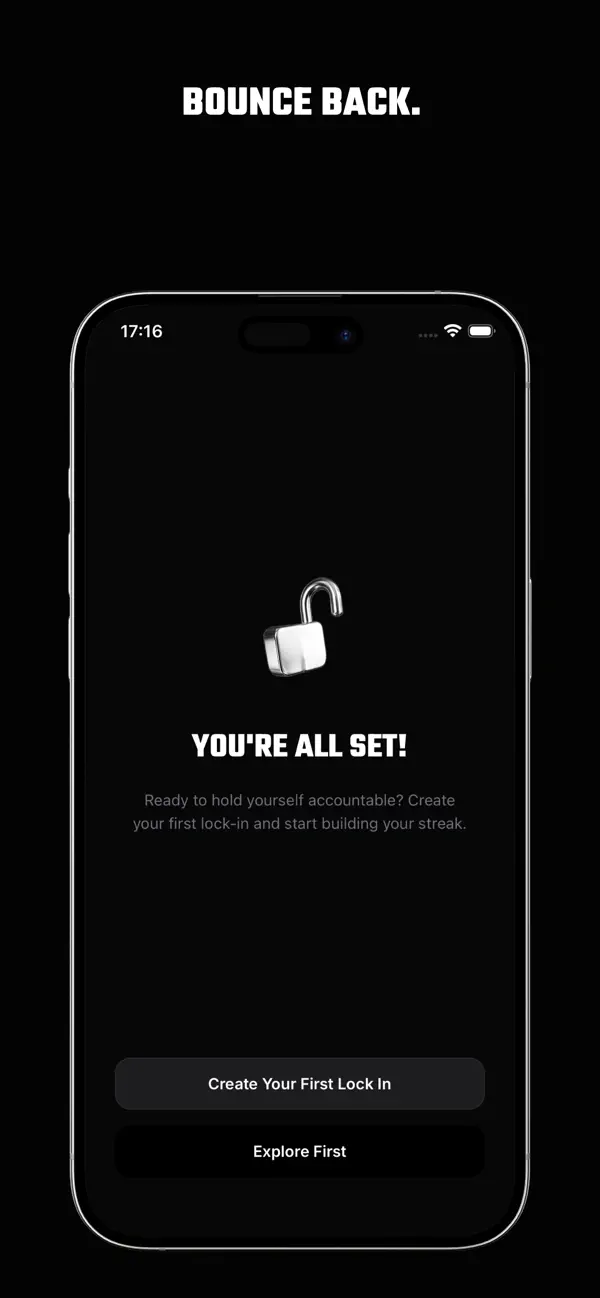
If you’d rather start from a list of ideas than a blank page, see these 30-day challenge ideas.
Common questions
How do you hold yourself accountable when no one is watching?
Make the check independent of your mood. Decide the rules in advance, check in at the same time every day with a yes-or-no question, and keep a record you’ll see. When no one else is watching, the record is your witness.
Why can’t I hold myself accountable?
Usually because the rules are still open. If the goal is vague, there’s no end date or a miss costs nothing, every day becomes a negotiation, and the tired version of you wins it. Close those gaps before you start: a checkable daily list, a finish date and a cost you’ve agreed to.
What can I do if I can’t find an accountability partner?
Start without one. Set the goal, the end date and the cost of a miss yourself, and keep a daily record. If someone reliable turns up later, add them as an extra check.
Are there apps to hold yourself accountable?
Yes. Some put money at stake and some pair you with a partner. Lock In takes the self-accountability route: one goal, a set number of days, every todo every day, and a missed day ends the run. Whatever you use, check that its rules match the ones you decided on, especially what happens after a miss.