
How to Lock In: Meaning, Steps and a Daily Plan
Updated
To lock in is to commit fully to one goal and stop renegotiating with yourself about it. The version that works is simple: pick one goal, set an end date, write two to four things you’ll do every day, and count each day as done or not done. Lock In turns that into a run with a fixed number of days, and it ends the run if you miss one.
This guide covers what the phrase means, five steps to lock in on a goal, what to do when motivation drops, and a 30-day plan you can copy today.
What “lock in” means
In slang, to lock in means to focus hard on one thing and shut everything else out. Athletes lock in before a big game; students lock in before finals. Online, the phrase has stretched past a single session: people talk about locking in on a goal for weeks or months and holding to it every day.
That longer sense is the useful one. A focused afternoon is good. A goal you keep showing up for until the date you set is better, and it’s the part most people struggle with. Every fall the idea even gets its own season, The Great Lock In, a 121-day challenge that starts on September 1.
Locking in isn’t about intensity. It’s about removing decisions. You decide once, up front, and then you do the work instead of deciding again every morning whether today counts.
How to lock in: five steps
These steps turn “I should really…” into a commitment you can check every day. Do them in order; the setup takes a few minutes.
Pick one goal
Choose one goal for this run and write it as something with a finish line: “finish the first draft”, “get my mornings back from my phone”, “read the books on my nightstand”.
One goal matters because every extra goal splits the same attention. If two feel equally urgent, run one now and make the other your next lock-in.
Set an end date
Open-ended goals drift. Pick a length you can see the end of: a week to test the setup, 21 or 30 days for a first real run, longer once you know the list holds. Write the end date down. It’s the day you finish, not the day you might review how it’s going.
Write a two-to-four-item daily checklist
Each item should be something you can finish today and check off without debate: “write 500 words”, “read 10 pages”, “walk for 20 minutes”. Size them for your worst day, not your best. A list you can finish when you’re tired or busy is a list you’ll still be running in week three.
Keep the same items every day. A list that changes daily turns back into a to-do list, and a to-do list is easy to renegotiate. For examples and how many to pick, see how to set daily goals.
Make every day pass or fail
At the end of the day, either every item is checked or the day doesn’t count. No partial credit, no “I did most of it”. Pass or fail keeps the record honest, and an honest record is what makes a streak mean something.
Decide now what a miss means
Decide what happens after a missed day before you start, while you’re calm. Some people allow one miss but never two in a row. Others choose a harder rule: a miss ends the run and the next attempt starts from day one. Whichever you pick, write it down. A rule you invent after the miss is just a way out. How to be consistent weighs the two rules.
How to lock in when motivation is low
Motivation comes and goes, and the setup above is built to work without it. When a day feels impossible, these help:
- Do the smallest item first. One checked box turns a blank day into a started one.
- Tie the list to something you already do, like breakfast, your commute or the moment you open your laptop, so it doesn’t wait for a free hour that never comes.
- Fix a list that’s too big in the next run, not today. Mid-run, the rule is the rule. Shrink the list when you set up the next lock-in.
- Keep the list where you’ll see it. A checklist you look at every morning is harder to forget than one you have to go looking for.
- Stop negotiating. You already decided. Today’s only job is today’s list. There are more ways to keep yourself to it in how to hold yourself accountable.
A 30-day lock-in you can copy
If you want to start today, here is a complete lock-in. It is Lock In’s Read Daily challenge with a goal attached; swap in your own books.
- Goal: read the books on my nightstand.
- Length: 30 days, starting today.
- Every day: read 10 pages, and write one sentence about what you read.
- If you miss a day: the run ends, and you start again from day one with the same list.
Ten pages is small on purpose. On a good day you’ll read more; on a bad day ten pages is still doable, which is why the list survives the third week.
Other lists that fit on one line come from the same catalog: “Write 500 words” and “Name tomorrow’s subject before you stop” for a writing month, “Walk for 20 minutes” and “Do 10 push ups” for moving every day, or “No phone for the first hour after waking” and “Get outside for 10 minutes” for your mornings. There are more in these 30-day challenge ideas.
How Lock In helps you lock in
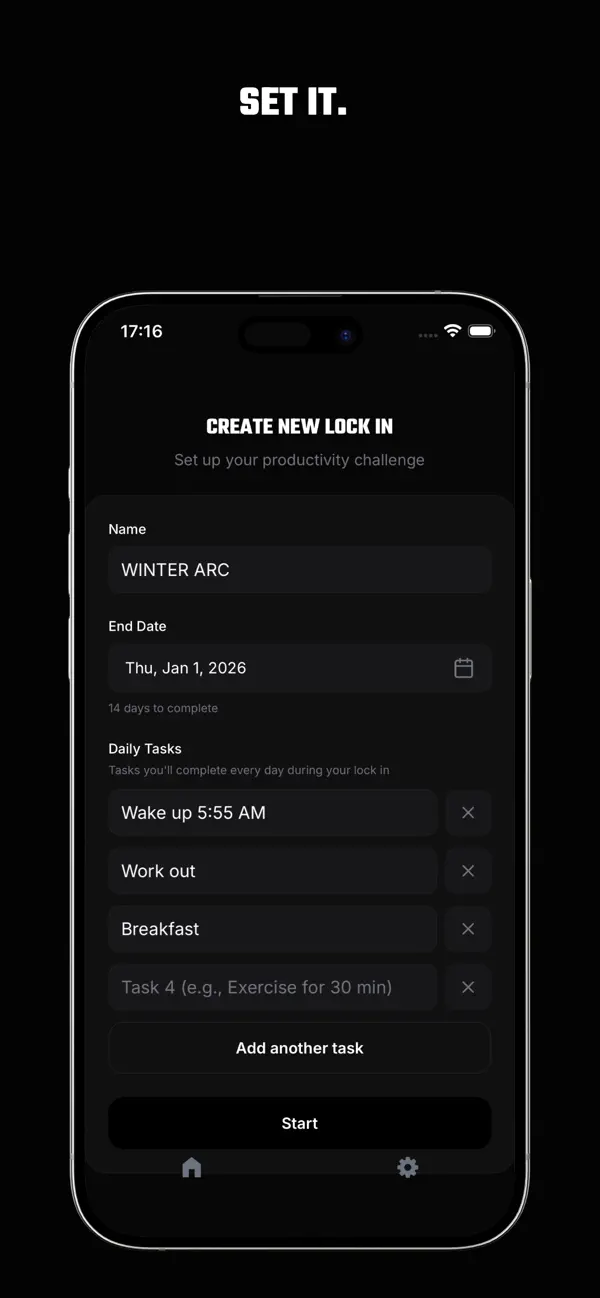
You can run all of this on paper. The Lock In app for iPhone is built around the same rules, so they hold even on the days you’d rather bend them.
- One goal, a set number of days. Name the lock-in, pick up to 365 days and list up to 20 todos. One lock-in runs at a time.
- Every todo, every day. A day banks only when every todo is checked, before your local midnight. Once it’s banked, a countdown shows when the next day unlocks.
- A miss ends the run. There’s no grace day, no streak freeze and no repair. Restart from day 1 with the same todos, and your attempts are counted.
- Help getting started. Start from one of 14 ready-made challenges, or, signed in, describe your goal in a sentence and get a drafted lock-in you can edit. Drafting is free until you create your first lock-in; after that, it’s part of Lock In Pro.
- Reminders if you want them. When you’re signed in, you can turn on reminders at 9 am and 9 pm your time, the evening one only when today isn’t banked yet, and a Live Activity shows today’s progress on your Lock Screen.
Lock In is free to download. Try it in guest mode without an account, or sign in with Apple or Google to sync across devices.
Common questions
Why is it so hard to lock in?
Usually the goal is vague, the list is too long, or there’s no end date, so every day turns into a fresh negotiation. Fixing those three, as in the steps above, removes most of the friction.
How do you lock in for 30 days?
Pick one goal, choose 30 days starting today (today is day one, so the end date is 29 days from now), write two to four small daily todos and treat every day as pass or fail. The plan above is a complete example.
Is locking in the same as being in the zone?
Not quite. Being in the zone is a state you fall into during a session. Locking in is a decision you keep for days or weeks. The daily checklist is what connects the two.
What if I miss a day?
Follow the rule you set before you started. If a miss ends the run, start a new attempt the next day from day one with the same list. That’s how Lock In handles it.