
How to Be Consistent With Goals and Habits
Updated
The short answer to how to be consistent: make the daily task small enough to do on your worst day, give it a fixed end date, and make a skipped day visible. Shrink the task until it takes minutes, pick the day you’ll finish, and decide in advance what you’ll do after a miss: start again the next day instead of waiting for a fresh Monday.
You don’t need more willpower for this. You need a setup that still holds on the days you have none.
Why consistency breaks
Most plans don’t fail on day one. They fade in week two or three, for one of three reasons.
The task is too big
“Work out for an hour” is fine on a good day. After a late shift and a bad night’s sleep, it doesn’t happen, and the plan now has a gap in it. A task sized for your best days will fail on your worst ones, and every plan meets a worst day.
There is no end date
“Read more” has no finish line, so there’s never a point where you’ve done it. Open-ended goals also make each skipped day feel cheap, because you can always start properly next week. A fixed end date turns a vague intention into a run you can finish.
A miss becomes a reason to quit
One skipped day is rarely the real problem. What it turns into is. “I missed Tuesday” becomes “this week’s gone,” which becomes “I’ll start again in January.” The miss costs a day. The story you tell about it can cost the whole goal.
This happens even to people who want the habit. In a 2010 study of habit formation, the researchers noted that about half of their volunteers, who had each picked their own behavior, didn’t do it consistently enough to reach habit status (Lally et al., 2010).
How to be consistent: five fixes
Each fix targets one of the failure points above. Set them up before you start.
Shrink the daily minimum
Write the smallest version of the task you’d still count as done. Then check it against your worst realistic day. If you couldn’t do it on that day, shrink it again.
- “Work out” becomes “Walk for 20 minutes.”
- “Write a book” becomes “Write 200 words.”
- “Learn Spanish” becomes “Do one lesson.”
You can always do more. The minimum is what you commit to. Keep the list short too: two to four todos is plenty. For more examples, see how to set daily goals you can finish every day.
Fix the end date
Pick a length and write down the day you’ll finish. Thirty days is a common first run. Seven days works if you’ve stalled before and want a quick finish. Go longer once a month feels easy. For a ready-made starting point, browse these 30-day challenge ideas.
Track pass or fail
Each day gets one of two marks: done or not done. No partial credit, no “mostly.” A day counts when every item on the list is checked. That keeps the record honest and the daily question simple: did I do it today?
Track it where you’ll see it daily: a paper calendar, a note on your phone or an app. The tool matters less than checking in every day.
Set a restart rule
Decide now, while you’re motivated, what happens after a miss. A good restart rule is short and says when you start again: “If I miss a day, I start again the next day.” Not next Monday, not the first of the month. The next day.
Also decide whether a miss resets your count to zero. That choice matters more than it looks, and the next section covers both options.
Review once a week
Pick a fixed time, such as Sunday evening, and ask three questions. Which days did I miss, and why? Is the minimum still small enough? What got in the way, and can I remove it? Adjust the setup before you lower the bar. If mornings keep failing, move the task to the evening.
Should one missed day end your streak?
There are two honest answers, and they point in different directions.
What the research says about missing a day
That 2010 study followed 96 volunteers who each chose an eating, drinking or exercise behavior and tried to do it daily in the same context, such as after breakfast, for 12 weeks (Lally et al., 2010). The participants whose data fit the model well took a median of 66 days, with a range of 18 to 254, for the behavior to become about as automatic as it would get, the point where more repetition stops making it more automatic. There’s no fixed number, and it’s often far longer than the 21 days you may have heard.
On misses, the paper is direct: missing one opportunity to perform the behavior “did not materially affect the habit formation process.” The authors contrast this with earlier research in which missing a whole week did hurt later performance. One slip isn’t the problem. A run of them is.
The forgiving rule: never miss twice
That finding supports a forgiving rule. In Atomic Habits, James Clear calls it “never miss twice”: if you miss a day, get back to it as quickly as possible, because “Missing once is an accident. Missing twice is the start of a new habit” (James Clear). Under this rule, one miss is a blip you recover from, not a reason to start over.
The strict rule: don’t break the chain
The strict version is the “don’t break the chain” method. Each day you do the task, you mark an X on a calendar. The X’s form a chain, and your only job is to keep it unbroken. Miss a day and the chain starts again from one.
Nothing in the research says the strict rule builds habits faster. People choose it for other reasons:
- No renegotiating. With a forgiving rule, every day holds a small question: is today the day I use my miss? With a strict rule, there’s nothing to decide.
- A clear finish line. A run either reaches its last day or it doesn’t. You always know where you stand.
- A real consequence. A miss costs you the run, so skipping has a price you can feel before you skip. That makes the rule a kind of commitment device, which the guide on how to hold yourself accountable without a partner explains.
The strict rule has a cost too. If a reset makes you want to quit altogether, it’s working against you, and never miss twice is the better fit. Pick the rule that keeps you going, and pick it before you start, not on the day you miss.
Lock In is built for people who choose the strict rule, and it pairs it with a restart rule: a miss ends the run, not the effort. You start again from day one with the same list.
A week-one plan
A simple first week, for a run of any length:
- Before day one. Pick one goal. If you’re stuck on that part, start with how to lock in on one goal. Write two to four daily todos that pass the worst-day test, set the end date, and write your restart rule on the same page.
- Days one to three. Do the minimum, and nothing more if you don’t feel like it. Mark each day done as soon as the list is finished.
- Days four to six. Notice when the list gets done, and tie it to something you already do every day, such as your first coffee or getting home from work. The volunteers in the study above did the same, with cues like “after breakfast.”
- Day seven. Run your first weekly review. If a todo felt heavy every day, note it and shrink it for your next run rather than skipping it in this one.
Where Lock In helps
Lock In is a daily commitment and streak app for iPhone built around the strict version of this method. Each fix maps to something in the app.
- Shrink the daily minimum. A lock-in is one goal with a list of daily todos. You choose the todos and the number of days, up to 365.
- Fix the end date. Every lock-in has a set number of days, so there’s always a finish line. You can also start from one of 14 ready-made challenges, from the 7-day First Seven to the 121-day Great Lock In, and edit it before you start.
- Track pass or fail. A day counts only when every todo is checked and you bank it before your local midnight. The note is optional.
- Set a restart rule. Miss a day and the run fails. There’s no grace day, no streak freeze, no repair and no catch-up. You can restart from day one with the same todos, and your attempts are counted. Or you can abandon the run.
- Review once a week. Every run gets a completion score out of 100: 60 for progress, 25 for your longest streak and 15 for consistency. With Lock In Pro, insights add your success rate, current, longest and average streak, an activity calendar, your best day and your best duration.
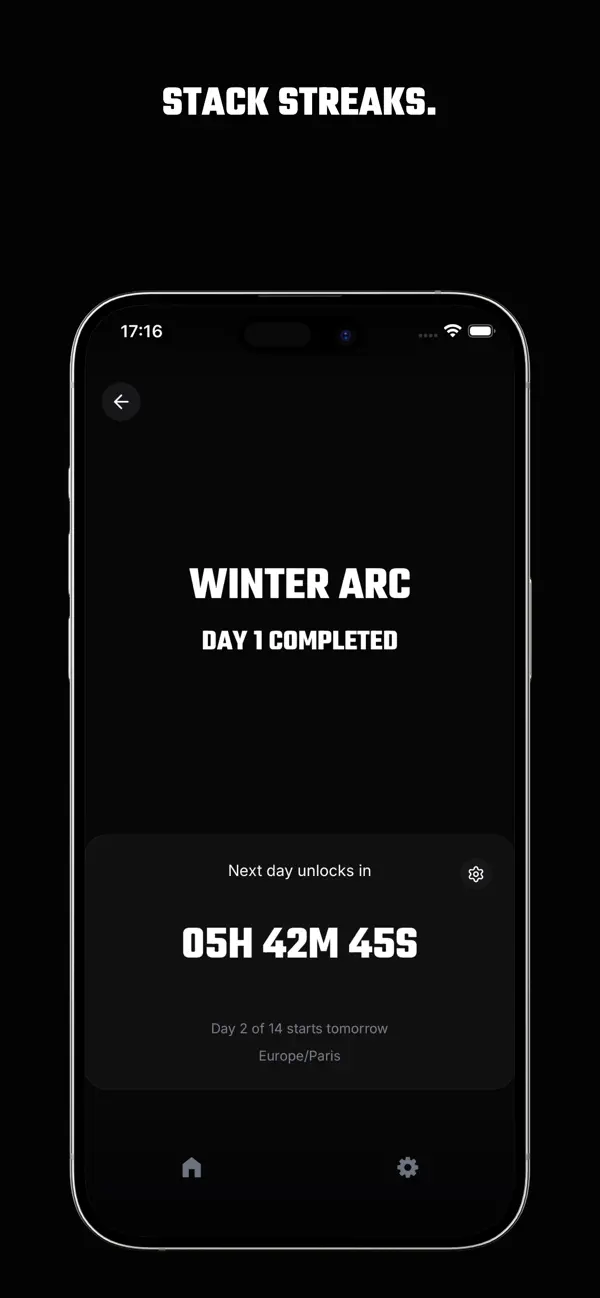
If you want a nudge and you’re signed in, turn on reminders at 9 am and 9 pm your time. The evening one only comes if today isn’t banked yet. You can also try the whole loop in guest mode, without an account: it keeps one lock-in on your device, with no history, and switching phones or clearing data can reset it.
Common questions
Why can’t I stay consistent with anything?
Usually the plan is the problem. The task is sized for a good day, there’s no end date, and one miss turns into a reason to stop. Shrink the task, set a finish line and decide your restart rule before you start.
How long does it take to build a habit?
Often much longer than 21 days. In Lally et al. (2010), the participants whose data fit the model well took a median of 66 days, with a range of 18 to 254, for a daily behavior to become about as automatic as it would get. It varies by person and by behavior.
Which matters more, discipline or motivation?
Neither lasts on its own. Motivation comes and goes, and discipline is easier when there’s less to decide. A small daily task, a fixed end date and a rule for misses make the decisions in advance, so you lean less on either.
How do you stay consistent with your goals when life gets hard?
Shrink the daily minimum before a hard stretch starts, not in the middle of it. Keep one small task that still counts, and keep checking in. If you do miss, restart the next day instead of waiting for things to calm down.